
Traci Park does not stand with working people. She aligns herself with the wealthy elite, corporate landlords, and business lobbyists who want to weaken worker protections, cut wages, and block policies that benefit working-class Angelenos. During her campaign, Park was funded by big business interests, police unions, and corporate landlords, many of whom have a direct financial stake in keeping wages low and eliminating workplace safeguards.
Since taking office, she has repeatedly prioritized the demands of business owners, developers, and corporate donors over the needs of the workers who keep Los Angeles running. She runs as a Democrat but was registered as a Republican until at least 2004, with no documented record of when she switched parties. Her voting record suggests the change may have been more strategic than ideological.
Before running for office, Park spent her entire career defending cities and corporations against workers who faced harassment, discrimination, wage theft, and retaliation.
This is a striking choice for someone raised in a union household. Traci Park’s father was a member of the Communications Workers of America, and her mother was a public school secretary who participated in organized labor activity. But Traci Park failed to internalized the lessons from this upbringing. Rather than embrace the fact that unions are the backbone of a fair economy, securing better wages, benefits, and job stability for working families, she turned her back on her family legacy and spent two decades working against workers. Park has continued to do the bidding of anti-labor forces from her seat on City Council.
Traci Park was trained at Littler Mendelson, one of the most notorious union-busting law firms in the world and a key player in anti-union campaigns at Amazon and Starbucks. While there, she co-authored an employer advisory warning that California’s paid family leave law could create new “union organizing pressures” for employers, framing a benefit for working families as a threat to management. She later joined Ogletree Deakins, another firm known for fighting workers’ rights, which once defended racist Arizona sheriff Joe Arpaio and the Republican Party in North Carolina against gerrymandering lawsuits.
At Burke, Williams and Sorensen, Park’s firm openly stated that she “exclusively assisted management,” meaning her job was to fight against workers’ rights on behalf of corporate and government employers. Since taking office, she has worked closely with corporate lobbyists who push for policies that undermine collective bargaining, refused to stand with hotel employees, grocery workers, and teachers who have demanded fair pay and safer conditions, and supported the outsourcing of public jobs to private contractors, eroding the foundation of unionized city employment.
Park’s record makes clear that she sees organized labor not as a partner in justice but as an obstacle to corporate profit. Her client list reads like a directory of corporate and institutional power. She defended Raytheon, one of the world’s largest weapons manufacturers, in multiple employment discrimination and wrongful termination cases. She defended FedEx against a disabled worker’s accommodation claims. She defended a home healthcare company against wage theft litigation.
In one particularly disturbing case, Harrell v. City of Anaheim (2021), Park argued that a white employee’s repeated use of the n-word around a Black colleague did not constitute harassment. The defense was so offensive that Black community leaders in Los Angeles held a press conference condemning her candidacy. In each case, her job was to make sure the employer won and the worker lost.
Since taking office, Park’s former firm has been awarded millions of dollars in city contracts, mostly to defend LAPD misconduct. In effect, Los Angeles taxpayers are now footing the bill for her ongoing campaign against workers and civil rights.
When workers organize for fair pay, safer workplaces, or humane hours, Traci Park is either silent or standing in their way.
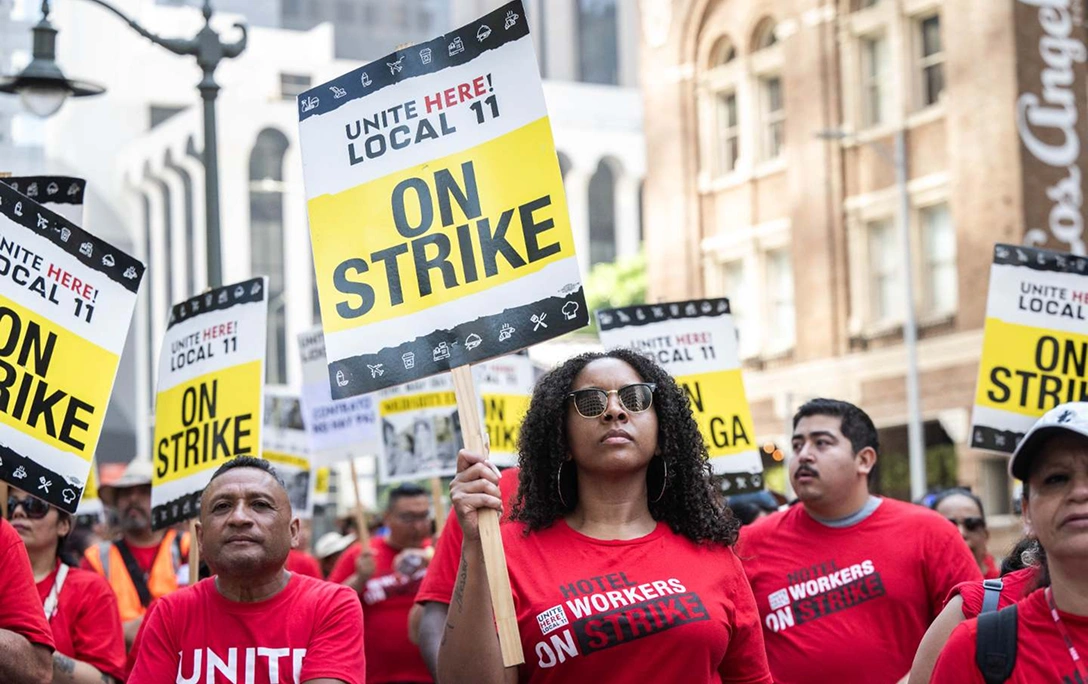
In May 2025, she voted NO on the Los Angeles Living Wage Ordinance, which raised the minimum wage for hotel and tourism workers to $25 an hour immediately and $30 an hour by 2028, one of the most significant labor victories in recent city history. She stood alongside hotel industry lobbyists at a press conference to oppose the raise, calling it “unprecedented” and warning it would cost jobs. These are the same apocalyptic predictions the industry makes about every wage increase, and which independent research consistently finds do not come true.
The Living Wage Ordinance passed 8 to 3 over her objection. In committee she declared she voted no because she did not think the ordinance was “thoughtful” and did not think “the time was right”. The hotel industry then poured millions into a referendum campaign to overturn the raise. That campaign failed, and the wage increase stands.
After Park voted against the hotel wage increase, Unite Here organized a text message campaign urging constituents to contact her office. Park responded not by engaging with the substance of workers’ concerns but by complaining on the Council floor. She used a hearing about alleged physical assaults on union campaigners to air her own grievances about being criticized. Unite Here co-President Kurt Petersen called her response “unbelievably narcissistic,” saying she had turned a moment when workers were pleading for help after being allegedly assaulted into an opportunity to complain about her own press coverage. Park replied by attacking the union and claiming it was “killing jobs and tanking our local economy.” She offered no acknowledgment of the workers whose wages she had voted to block.
Park also voted NO on the city’s fiscal year 2025-26 budget, which funds the Office of Wage Standards, the agency responsible for enforcing wage theft laws in Los Angeles. When a motion came before the Council to strengthen that enforcement by giving the Office of Wage Standards tools to investigate unpaid overtime, stolen tips, and skipped meal breaks, Park questioned whether the city needed to act at all and suggested enforcement rules should be shaped by input from the business community, including identifying any exemptions employers might want. She essentially was calling for the fox to guard the henhouse.
This is the same Traci Park who talks constantly about law and order and stands shoulder to shoulder with City Attorney Nathan Hochman issuing stern warnings about retail theft and shoplifting. When a corporation’s inventory walks out the door, Park wants action. When employers steal $1.4 billion a year from workers, with low-wage employees losing roughly 12.5 percent of their annual income and immigrant workers suffering violations at twice the rate of US-born workers, Park wants to know what exemptions the business community would like. The difference is whose property is being taken.
When the Palisades Fire tore through Pacific Palisades in January 2025, Traci Park moved quickly to champion emergency measures for her most affluent constituents, including debris removal, infrastructure repair, business tax relief, and rebuilding support for homeowners whose properties averaged $3.5 million in value.
What she did NOT do was fight for the thousands of low-wage workers whose livelihoods burned alongside those mansions. Housekeepers, gardeners, nannies, and maintenance workers who had spent decades building their lives around the Palisades economy lost their income overnight. People like Carol Mayorga and her husband, whose entire livelihood was tied to the Palisades neighborhood where they worked seven days a week but could not afford to live, lost nearly ten client properties in a week.
In February 2025, the Council considered a motion to protect these workers, prohibiting evictions for tenants who could show economic hardship from the fire and pausing rent increases while they got back on their feet. The motion had already been scaled back significantly from its original form after pushback from landlords. Park voted no. The motion failed 6 to 5. The workers who cleaned the homes, tended the gardens, and cared for the children of Pacific Palisades were left without protection while eviction rates in the city climbed to 2,400 per month in the weeks following the fire.
Traci Park found emergency urgency for property owners, but for the workers who served them, she had procedural concerns. And her obstruction was decisive. LA City Council operates on a strong norm of deference to the local councilmember on matters affecting their own district, so when Traci Park opposed any protections for low-wage workers in the Palisades, she effectively killed the motion.
In the wake of one of the worst disasters in Los Angeles history, people across the city looked to their representatives for leadership. Park stepped up for homeowners with million-dollar properties and stepped over the housekeepers, gardeners, and nannies who had built their working lives in that same neighborhood. She drew a clear line around who deserved her protection and who did not.
Park’s anti-worker record is no accident. It is the product of who funds her political career. Her campaign was bankrolled by corporate landlords, luxury developers, and powerful business groups that have fought against every major pro-worker reform in recent memory. She took major donations from the hotel and tourism industry, which has long exploited low-wage workers and opposed unionization, and from corporate real estate interests including Douglas Emmett and Kilroy Realty that resist fair pay and job security for maintenance staff, security guards, and janitors.
Traci Park’s biggest donors include developers and business associations that lobby against living wages, paid sick leave, and stable employment. The individuals and corporations who bankroll Park profit directly from keeping workers poor.
Traci Park’s budget choices reveal her clearest betrayal of working Angelenos. In May 2025, she voted against the city budget while publicly describing homeless spending as “a bottomless pit” and complaining about housing for “homeless drug addicts.”
While claiming the city cannot afford fair wages for its workforce, Park has consistently voted to expand LAPD funding at the expense of essential services. She supported a massive police hiring push even as departments like Sanitation, Recreation and Parks, and Public Works faced dangerous staffing shortages. She approved bloated overtime budgets for police while rejecting cost-of-living adjustments for city employees.
Traci Park’s priorities are simple: Police and corporate donors come first, while the workers who keep Los Angeles functioning are told their livelihoods don’t matter.
While Traci Park’s donors benefit from rising corporate profits and real estate speculation, working-class families in Council District 11 are falling further behind. Rents continue to rise, healthcare remains out of reach, and wages lag behind inflation. Instead of using her office to make life more affordable for working people, Park has opposed stronger labor protections for gig workers and ignored the struggles of janitors, grocery clerks, and delivery drivers, the essential workers who kept this city alive through the pandemic.
The pattern extends beyond votes. When the Westside FamilySource Center — the district’s only comprehensive anti-poverty hub, providing workforce services, financial coaching, tax preparation, immigration legal help, and emergency assistance to low-income families — was slated to lose its funding, Park’s office knew months in advance and did nothing. Records show her staff was warned directly by the service provider that the closure was coming and that families would be left without support. Park did not intervene, did not seek an exception, and did not advocate to preserve the services while the decision was still reversible.
The center closed in early 2023, taking with it roughly one million dollars a year in federal funding for underserved families and eliminating critical immigration legal services at a moment when ICE enforcement was intensifying across the Westside. When displaced families began calling Park’s office for help, her staff responded not with compassion but with frustration, accusing the service provider of being “disrespectful” for directing constituents to their councilmember. Her policies have helped drive up the cost of living and pushed working Angelenos out of the neighborhoods they serve. And when the safety net frays, she looks the other way.
Working people deserve leaders who fight for them, not politicians who take money from anti-worker donors and side with corporations over constituents. Los Angeles needs a councilmember who will champion fair wages, union rights, and dignity on the job, not one who sells out workers to the highest bidder. Traci Park does not represent working people. She represents the powerful few who profit from their exploitation.