
Traci Park has built her political identity around public safety, but her record has repeatedly made Los Angeles less safe. She has expanded policing and mass surveillance and opposed reforms designed to prevent harm before it happens. She has backed criminalization over prevention, resisted safer streets, and repeatedly sided with enforcement-first approaches over evidence-based public safety solutions. The result is a clear pattern: she’s for more punishment, weaker prevention, and a narrower vision of safety that leaves Angelenos less safe, not more.
Traci Park has built one of the most aggressively pro-police records on the Los Angeles City Council, and police interests have invested heavily in keeping it that way.
The Los Angeles Police Protective League (LAPPL) has given Park more than $400,000 in direct contributions, but that only tells part of the story. In 2022, a LAPPL-sponsored independent expenditure committee raised more than $1.7 million supporting her election. So far in 2026, police-backed committees have raised another roughly $900,000 for her reelection, with LAPPL directly supplying nearly $900,000 into those operations across both cycles. Major corporate landlords and real estate interests including Douglas Emmett and Kilroy Realty routed hundreds of thousands more through police-sponsored political expenditures.
Police are not simply one constituency among many in Park’s coalition. Alongside corporate landlords and right-wing donors, the police union is a central financial force powering her political operation, and police unions do not spend millions electing politicians out of charity. They spend it to shape who governs and how. Park’s record consistently aligns with the priorities of one of the most heavily funded, politically powerful, and violent police unions in the country. Voters should ask: Does her public safety agenda reflect what actually keeps communities safe, or is she doing the bidding of the police union?
Police invested heavily in Traci Park’s political operation, and her record suggests they’ve seen a strong return on that investment. Throughout her time in office, Park has consistently supported giving LAPD more resources, staffing, technology, equipment, and broader enforcement authority while opposing efforts to place stronger guardrails around police power.
Park voted to expand LAPD helicopter resources, backed additional police staffing and hiring, and supported overtime funding while publicly criticizing attempts to slow police hiring. During 2025 budget deliberations, she described a 240-officer hiring cap as a “low-ball cap” and “essentially a cut to the department,” arguing Los Angeles should hire substantially more officers.
What happened next raised larger questions about accountability and democratic governance. Facing a nearly $1 billion budget crisis, City Council deliberately reduced LAPD hiring to 240 officers to avoid deeper cuts elsewhere in city government. LAPD ignored that limit entirely, hiring roughly 170 officers beyond what elected officials had approved. Rather than enforcing the democratically adopted budget, Council ultimately voted to authorize additional funding and retroactively ratify the expansion already underway. Park supported LAPD’s over-budget hiring and publicly criticized limits on police staffing.
The message was unmistakable: when City Hall votes to spend less on policing, LAPD can continue expanding anyway, and elected officials will find the money afterward. Police spending operates under a different set of rules than the rest of city government.
Park’s support for police extends beyond personnel and budgets. She consistently voted in favor of LAPD equipment expansion, including K-9 units, gym upgrades, facility improvements, specialized equipment, and LAPD’s controversial quadruped robotic ground vehicle program, despite public opposition from community members who warned against further police militarization and surveillance expansion.
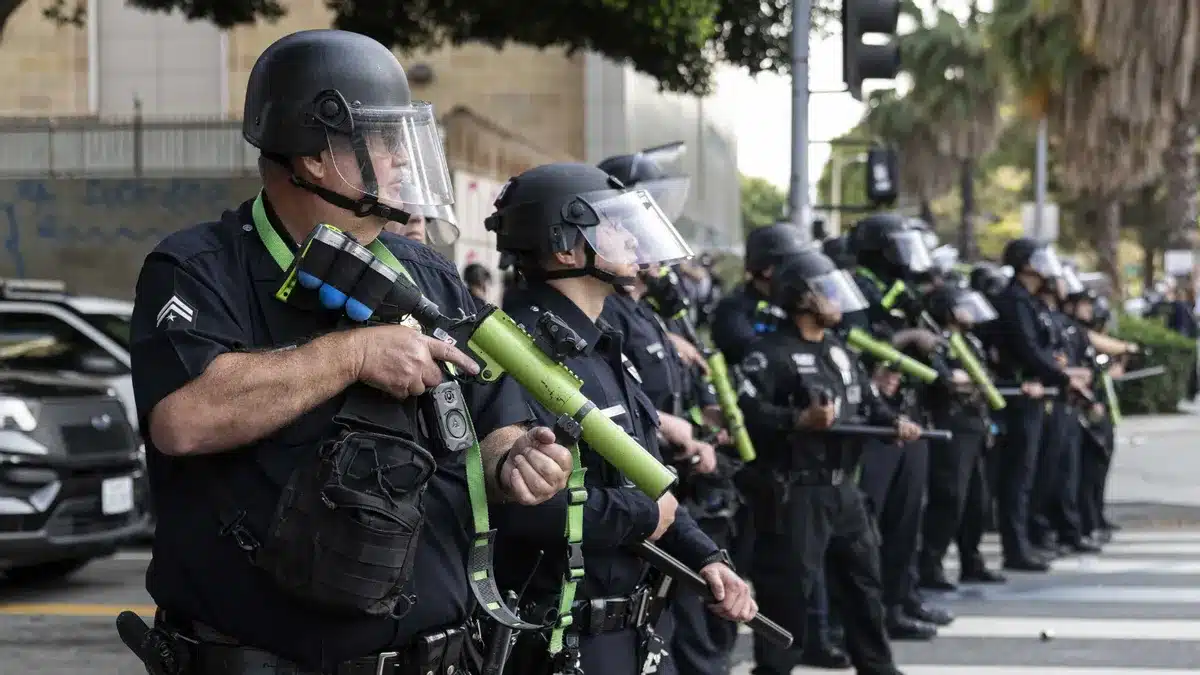
Park has also opposed efforts to limit police authority. In 2025, she cast the lone no vote against curbing pretextual traffic stops, a racist policing tactic with well-documented disproportionate impacts on Black and Latino communities. When Angelenos took to the streets in June 2025 to protest ICE raids, she voted against restrictions on LAPD’s use of 40mm projectile launchers and tear gas for crowd control, despite years of public criticism over injuries, misuse allegations, and lawsuits tied to police responses to protests.
The votes reflect a broader pattern. When opportunities emerge to place guardrails around police discretion or limit uses of force, Park repeatedly aligns herself with perpetuating police violence.
LAPD has one of the longest and most troubled histories of police violence and misconduct in the country. From the Rodney King beating and the Rampart scandal to repeated federal intervention and ongoing accountability failures, Los Angeles taxpayers have spent decades paying enormous financial and human costs tied to policing. More than 100 criminal convictions were overturned after Rampart alone, resulting lawsuits cost roughly $125 million, and federal civil rights intervention lasted more than a decade.
Even as crime falls, policing continues expanding. Los Angeles reported major crime declines in 2025, including a 19% drop in homicides and the city’s lowest homicide count since 1966. LAPD violence moved in the opposite direction.
During Park’s tenure, LAPD officers opened fire on people 118 times between January 2023 and mid-May 2026. Officer-involved shootings totaled 34 in 2023, fell to 29 in 2024, then surged to 46 in 2025, the department’s highest total since 2015. Many shootings involve people in mental health crisis, and department reviews found officers firing nearly twice as many rounds per shooting as four years earlier. The violence disproportionately impacts Black and brown communities, which already face disproportionate rates of stops, arrests, and enforcement.
The financial costs are staggering. Liability payouts hit a record roughly $286 million in Fiscal Year 2024-25, and city liability costs have exceeded $1.1 billion since Park took office. Police misconduct claims alone have cost approximately $384 million since 2019, with nearly half tied to shootings, excessive force, and civil rights violations. Following anti-ICE protests in 2025, police operational costs alone climbed above $30 million, not counting future legal exposure from protest-related lawsuits.
This is the hidden cost of Park’s public safety model. Los Angeles pays once to expand policing, then pays again for misconduct, civil rights violations, shootings, and liability claims. Every dollar diverted to settlements and endlessly expanding policing is a dollar unavailable for housing, mental health care, youth programs, and the investments proven to reduce crime before it happens.
Traci Park is rapidly expanding networks of automated license plate readers, real-time crime infrastructure, and AI-assisted policing tools across the Westside at precisely the moment communities across the country are waking up to how dangerous these systems are. Surveillance technologies sold as crime-fighting tools increasingly raise concerns about privacy violations, immigration enforcement exposure, mission creep, and the normalization of tracking ordinary people who have done nothing wrong. Cities are beginning to pause contracts and ask harder questions. Traci Park is moving in the opposite direction.
In December 2024, Park announced 100 new automated license plate reader cameras for Council District 11 and directed $450,000 toward surveillance expansion. But public records later raised serious questions about where that money went. A detailed spending review found no direct ALPR purchases tied to Park’s discretionary allocation. Instead, camera deployment moved forward through private Los Angeles Police Foundation donations outside normal procurement systems, while city funds were redirected toward other LAPD equipment and tactical infrastructure.
Modern ALPR systems are considerably more powerful than simple crime cameras. Flock Safety systems can capture every passing vehicle, analyze movement patterns, identify repeat visits to locations, map associations between vehicles, and create historical records searchable across jurisdictions. The overwhelming majority of people pulled into these systems have done nothing wrong. Research found that 99.9 percent of LAPD license plate scans involved vehicles not associated with any criminal activity when captured.
Once collected, information rarely stays confined. A 2025 University of Washington human rights report found Border Patrol had accessed locally collected license plate data in multiple jurisdictions without explicit authorization, while other agencies conducted searches on behalf of ICE. Families across Los Angeles increasingly navigate daily life knowing surveillance systems can transform ordinary movement into searchable enforcement intelligence. And there is no strong evidence mass surveillance meaningfully reduces crime. One study found less than 0.3 percent of license plate reader hits translated into useful investigative leads.
Traci Park calls this public safety. But when surveillance expands without meaningful public input, private donors help build policing infrastructure outside ordinary oversight channels, and communities raise concerns while elected officials keep accelerating anyway, voters should ask: Who gets protected by this system, and who gets watched?
Traffic violence is one of Los Angeles’ largest public safety failures, and Traci Park has repeatedly worked to slow, weaken, or block the infrastructure designed to prevent it.
Park rode a wave of Westside backlash politics into office that treated transportation safety improvements as a threat rather than a solution. Opposition to protected bike lanes, bus improvements, road diets, and pedestrian infrastructure became central organizing issues for the coalition that powered her rise. Projects intended to reduce crashes and save lives were reframed as attacks on parking, convenience, and car access.
That politics followed her into office. Before she was even sworn in, Park attempted to block $5.1 million in Westside transportation investments. She attacked the Venice Boulevard Mobility Project despite years of planning and community outreach, and has since worked to delay or undermine multimodal improvements including the Lincoln Boulevard Multimodal Bridge Improvement Project.
Park also campaigned against Measure HLA before Los Angeles voters approved it by wide margins in 2024. The measure simply requires the city to implement portions of its own Mobility Plan when major street repaving occurs. Council District 11 backed HLA by roughly 60 percent. Park continued criticizing and blocking implementation anyway.
The contradiction reflects a larger pattern. Park frames public safety through policing, surveillance, and enforcement. But when public safety means redesigning dangerous roads or building infrastructure proven to reduce deaths, that urgency disappears.
Traffic crashes remain the leading cause of death for children and teenagers in the United States. Research consistently shows that protected bike lanes, traffic calming, safer crossings, and street redesigns save lives. Safe streets are not cosmetic improvements. They are public safety infrastructure.