
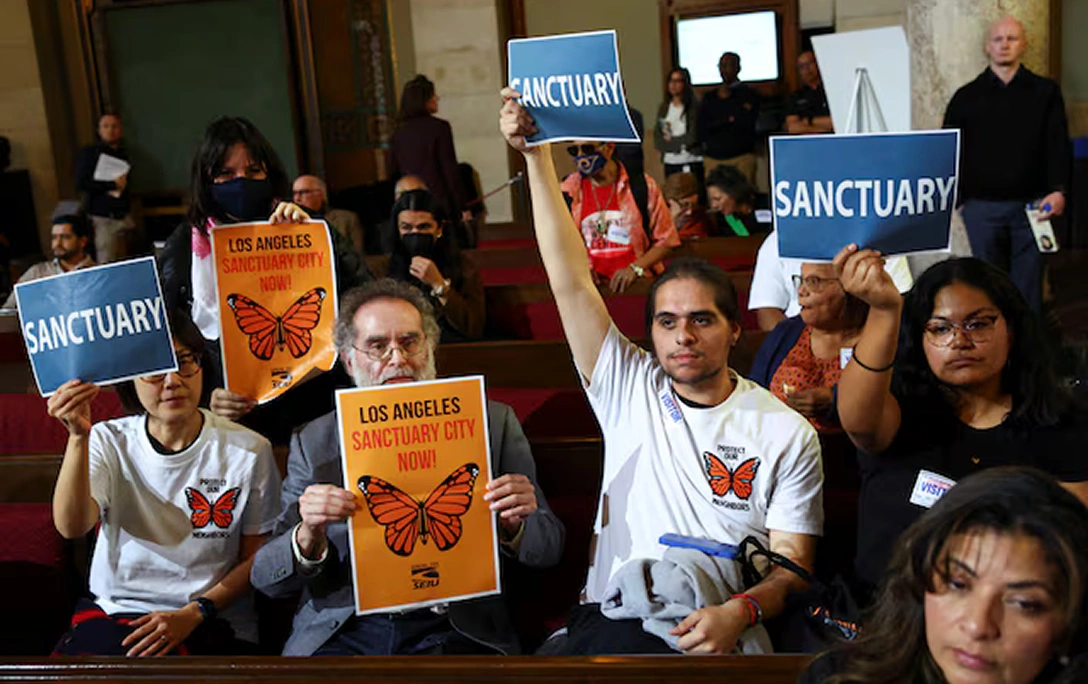
Traci Park opposes Los Angeles’ sanctuary city protections, supports cooperation with ICE, and has never condemned the raids that are terrorizing immigrant families on the Westside. She has also opposed expanding legal aid for immigrants facing deportation, voting against providing lawyers to detained and non-detained immigrants whose families risk being permanently separated. Instead, she has pushed mass surveillance, backed expanded LAPD power, and voted to protect police violence against protesters demanding an end to deportations.
Traci Park has repeatedly opposed efforts to strengthen Los Angeles’ sanctuary protections. In interviews and official updates, she has framed sanctuary policy as symbolic, risky, and potentially dangerous, arguing that the city must preserve flexibility to cooperate with federal immigration authorities. She has repeatedly invoked the trope of “violent criminals” to justify this position, despite the fact that current immigration enforcement is sweeping and indiscriminate.
In her public statements, Park consistently avoids naming ICE as the source of harm. She describes fear, economic disruption, and families staying home, but treats immigration enforcement as an external and unfortunate force rather than something shaped by local policy choices. Even when she admits that federal promises to target only serious offenders do not match reality, she stops short of condemning ICE or calling for noncooperation.
Park has aggressively pushed to expand mass surveillance across the Westside. She has championed license plate reader cameras, real time crime infrastructure, and expanded data collection, all under the banner of public safety.
These systems collect detailed location and movement data that can be shared across law enforcement agencies. Civil liberties groups and investigative reporting have repeatedly warned that such data is routinely accessed by federal agencies, including ICE, even in sanctuary jurisdictions. Park has never proposed enforceable limits on how surveillance data can be shared, retained, or accessed, nor has she addressed how these tools undermine sanctuary protections in practice.
This creates a clear contradiction. Park claims concern about immigrant fear while advancing the very infrastructure that allows federal enforcement to track, locate, and detain people quietly and efficiently. The fear she describes is not abstract. It is embedded in the systems she continues to expand.
Park’s dedication to expanding police power extends to how she votes when that power is challenged. When the City Council considered an amendment to pause LAPD’s use of 40mm munitions and tear gas after these weapons were deployed against protesters, including people demonstrating against ICE activity, Park voted against it.
The amendment was introduced after hundreds of projectiles were fired into crowds that included journalists and bystanders. It was designed to introduce accountability and ensure compliance with state law. Park chose instead to preserve LAPD discretion, even when that discretion had been used against people protesting deportations and state violence.
Her vote made clear that when forced to choose between civil liberties and police authority, she sides with the police.
Park’s rhetoric about crime and enforcement has been loud. Her response when immigrant residents of the Westside were detained, disappeared, or effectively kidnapped by ICE has been silence.
She has never publicly named or mourned the Westside community members taken by federal agents. She has not attended vigils, amplified mutual aid efforts, or acknowledged the local organizations supporting affected families. Her newsletters and updates during this period focused instead on policing, surveillance, and enforcement priorities.
This silence is not incidental. It reflects a political choice about whose safety matters and whose suffering can go unnamed.
Across her video updates and legislative communications, one theme is constant. More police hiring is always the priority. Park repeatedly warns that Los Angeles is “dangerously understaffed” by officers and treats increased LAPD staffing as nonnegotiable, even during a severe budget crisis
She has supported LAPD expanding its ranks beyond what the city budget authorized, forcing the Council to retroactively fund millions in staffing costs while other departments face cuts. She does not acknowledge alternative public safety models or the opportunity cost of pouring more money into a department that already receives extensive funding, military grade equipment, and political backing from the Police Protective League.
Park’s conception of safety is singular and enforcement driven. Social services, unarmed crisis response, and prevention do not register.
Park is also a staunch supporter of LAPD Chief Jim McDonnell, whose record includes collaboration with ICE and open defiance of public health measures. She has continued to back his leadership even as he stated he would refuse to enforce a state mask ban for ICE agents, reinforcing a pattern of selective law enforcement aligned with right-wing politics.
Her ideological alignment became unmistakable when Donald Trump visited Los Angeles. Park publicly addressed him in glowing terms, saying:
“Mr. President, my name is Traci Park. I represent the people of the Pacific Palisades on the LA City Council. I wanted to thank you for your loyal support to our military, our police officers and especially our firefighters.”
This was not a neutral courtesy. She explicitly thanked the president for his loyal support to the military and police at a time when his administration was carrying out mass deportations, undermining sanctuary cities, and attacking immigrant communities nationwide.
Traci Park has ignored repeated calls from organizers to expand tenant protections for mixed-status households, to fund deportation defense and legal aid for immigrants facing removal, and to guarantee that city data will never be shared with federal immigration enforcement.
When the City Council considered expanding funding to provide lawyers for immigrants in deportation proceedings, Park opposed it, leaving families vulnerable to removal simply because they could not afford counsel. Her actions show indifference, not leadership. Park’s district includes thousands of immigrant workers who clean homes, cook in restaurants, and sell food on sidewalks. Yet she has done nothing to defend their safety or dignity.
Los Angeles is a city built by immigrants, from the Oaxacan families who run food stands in Venice to the Filipino nurses who staff our hospitals to the Central American day laborers who build our homes. These residents are the heart of the Westside, yet Traci Park treats them as disposable.
Taken together, the pattern is clear. Traci Park opposes sanctuary protections. She expands surveillance that feeds deportation. She votes against legal defense for immigrants facing deportation. She votes to preserve police violence against protesters. She refuses to condemn ICE. She stays silent when her constituents are taken. She pushes nonstop police hiring while the city faces fiscal collapse. She praises a president whose immigration agenda relied on fear, militarization, and mass removal.
This is not contradiction. It is coherence.
Los Angeles deserves leadership that defends immigrant communities with action, not reassurance. Park has chosen enforcement, surveillance, and police power every time.