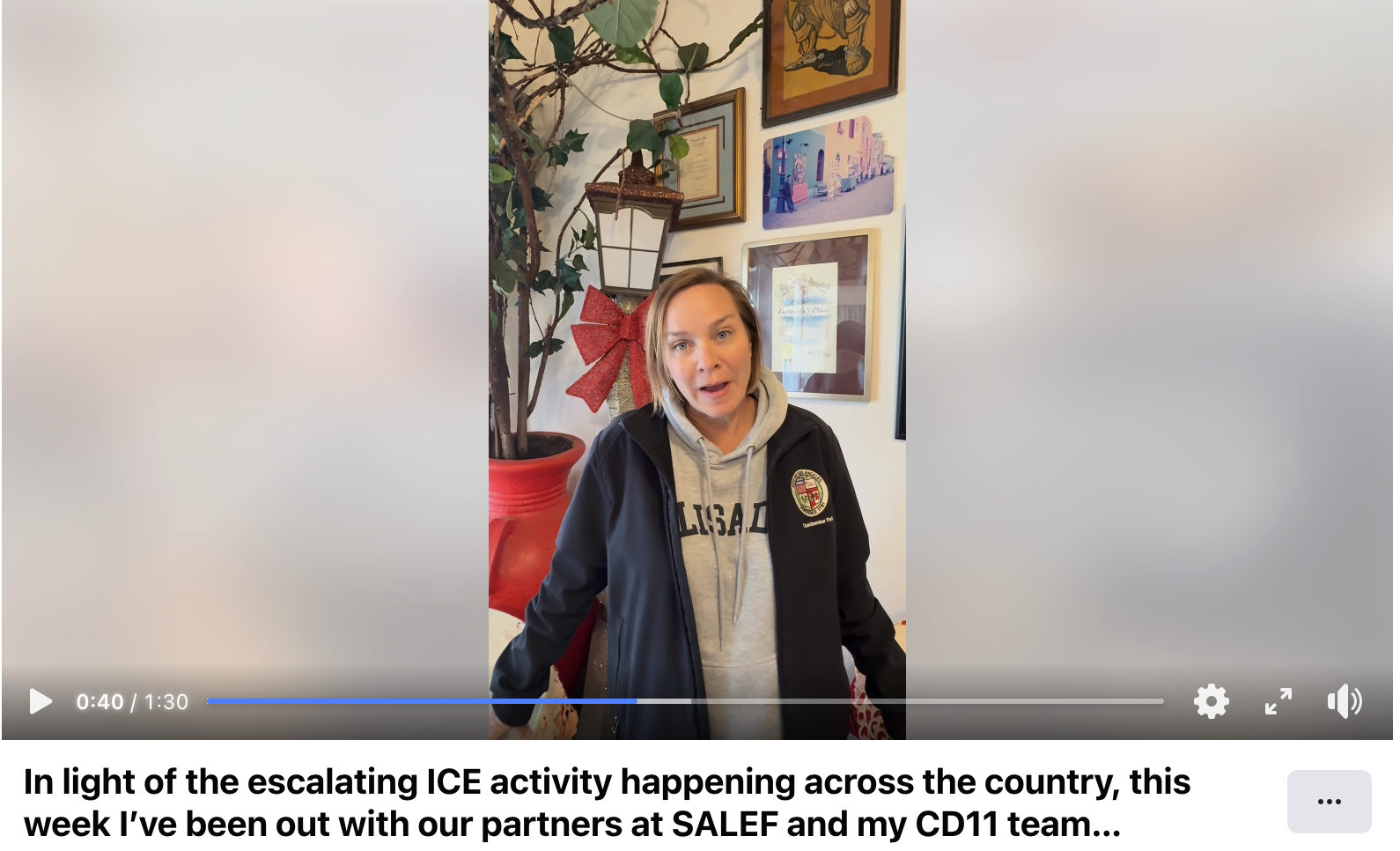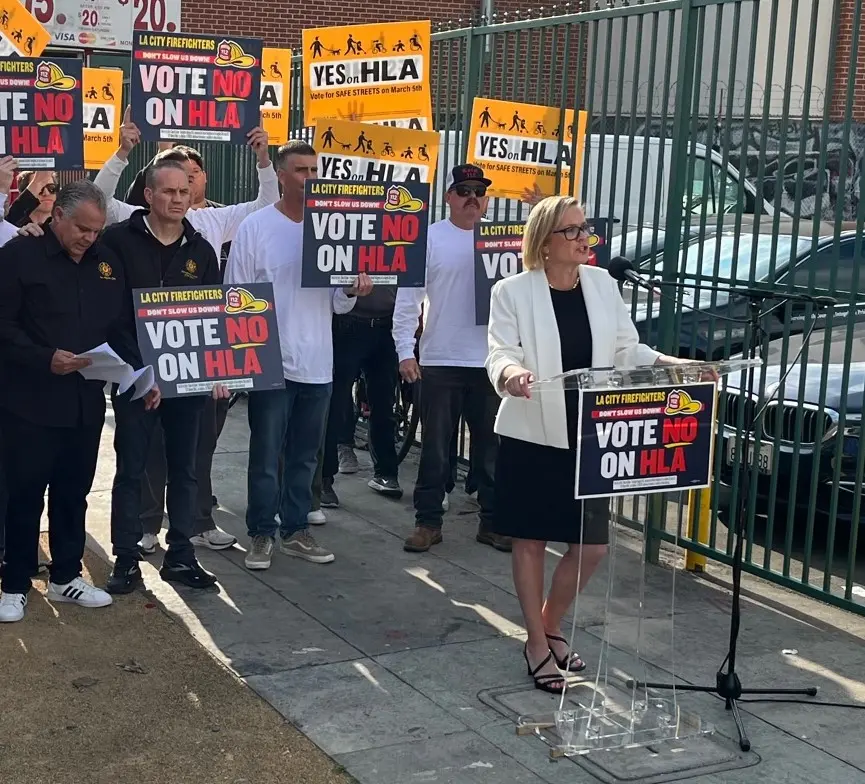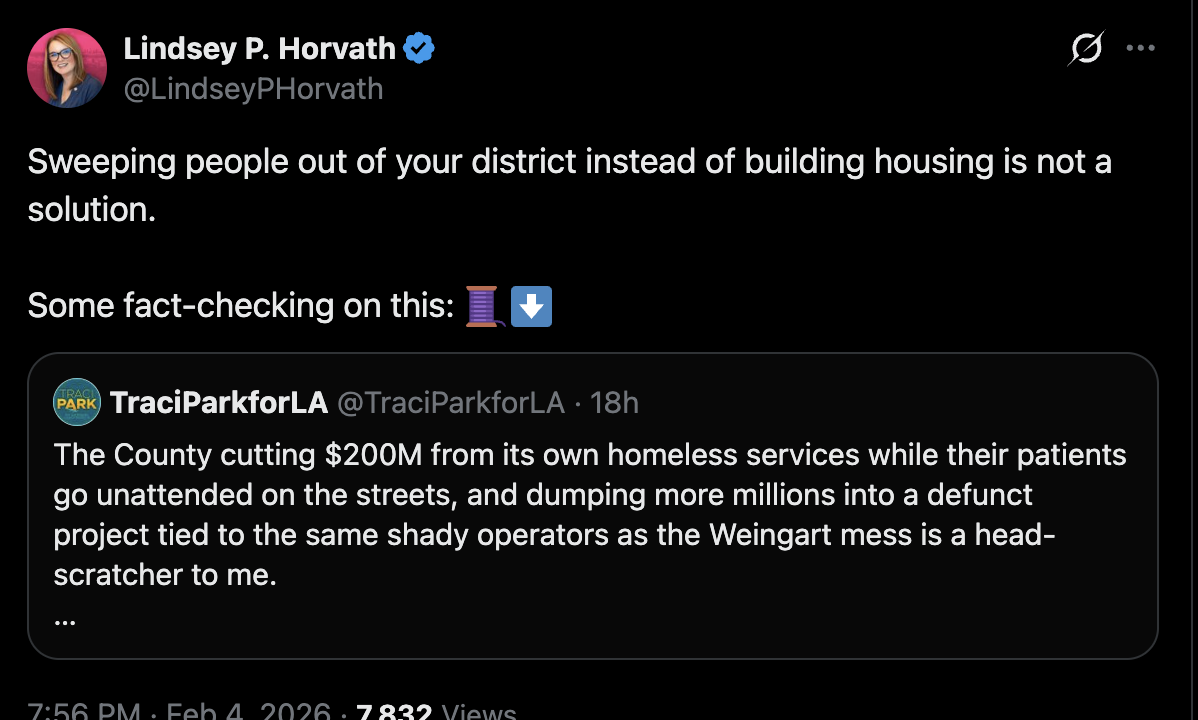
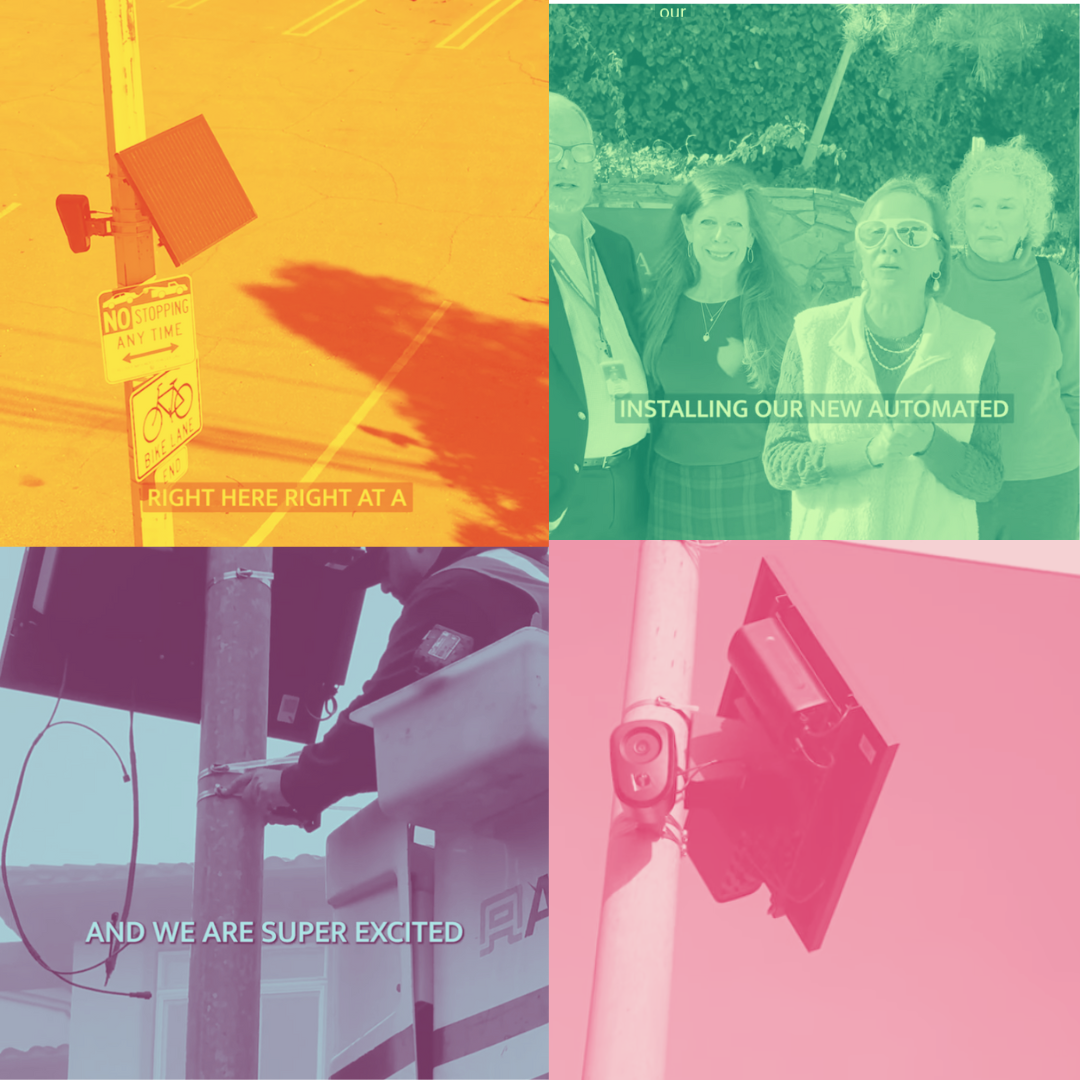
Traci Park is bringing mass surveillance to the Westside. She’s expanding police and ICE tracking power at the exact moment when those systems are being used nationwide to hunt immigrants, track protesters, and criminalize entire communities. And she’s doing it enthusiastically, on camera, standing under newly installed automated license plate reader (ALPR) cameras and selling them as common sense upgrades while the country is watching surveillance infrastructure be folded directly into deportation operations, political repression, and the erosion of basic civil liberties. Park is moving in this direction even as cities and states across the country are tearing these systems out, canceling contracts, and publicly admitting that they were misled about what this technology would become once it was embedded into policing, shared across jurisdictions, and quietly opened to federal enforcement.
In video after video, Park stands beneath newly installed ALPR cameras and sells them as a cure all for fear, staffing shortages, and political discomfort. She keeps framing mass data collection as common sense and inevitable rather than as an extraordinary and terrifying expansion of state power. In Pacific Palisades, she praises what one supporter openly calls “a virtual gated system for our community,” celebrating the idea that cameras at “each major intersection leading into the Palisades” can tag cars, follow them across neighborhoods, and alert police when a vehicle moves from Brentwood or Beverly Hills into the canyon. This is not a slip of the tongue. She’s promoting a digitally enforced gatekeeping system for the wealthy, paid for by all of us.
In Westchester, Park explicitly embraces artificial intelligence as a substitute for people, judgment, or restraint, saying “this gives us a chance to use AI to augment the police,” while repeatedly tying the rollout of ALPR cameras to LAPD staffing shortages, as if the answer to democratic accountability is permanent tracking rather than fewer armed officers and more public investment. In Mar Vista and Venice, the pitch barely changes. Cameras are justified because crime is supposedly everywhere, because response times are slow, because jurisdictional boundaries are messy, because people feel unsafe. At Venice and Sawtelle, a staffer openly explains that the cameras are designed “to read license plates that can track vehicles to different points in our district,” celebrating movement tracking itself, not the investigation of specific crimes. In Venice on Washington Boulevard, Park describes ALPRs as “one piece of the security infrastructure that we are building out all over the west side of Los Angeles,” language that mirrors exactly how the Trump administration and surveillance vendors describe nationwide enforcement networks.
What Park never mentions is that this model is already collapsing elsewhere because the evidence of its dangers is becoming impossible to ignore.
Santa Cruz terminated its Flock Safety contract and Denver restricted its contract after audit logs revealed extensive immigration related searches despite public assurances to the contrary. Syracuse ended its ALPR program after learning that its local data had been searched millions of times by outside agencies, including ICE, without warrants or public approval. Austin declined to renew its Flock contract outright, with councilmembers stating clearly that the city should not be participating in a national surveillance network that feeds federal immigration enforcement. Evanston revoked out of state access to its license plate reader system after discovering ICE searches in violation of state law. Richmond cut off data sharing with federal agencies after learning its ALPR system had been used for immigration enforcement without the city’s knowledge. Entire city councils in Denver and other jurisdictions have voted unanimously against renewing these contracts, citing civil liberties risks that cannot be mitigated.
At the state level, lawmakers are scrambling to contain damage already done. Washington State is advancing new legislation after audits showed that local agencies quietly shared ALPR data with Border Patrol despite sanctuary policies. Illinois passed laws explicitly banning the use of license plate reader data for immigration enforcement, only to see police violate those laws almost immediately through backdoor access and shared logins – surprise surprive. Minnesota and Massachusetts have restricted data sharing after ICE was caught using local surveillance systems. Even conservative states like Montana and Idaho have enacted protections recognizing that warrantless location tracking violates basic Fourth Amendment principles.
This is the context Park is actively defying, charging headfirst in the opposite direction as evidence mounts that these systems are dangerous, ungovernable, and already being weaponized. While other jurisdictions are stepping back, tightening rules, or dismantling systems altogether because they have seen how easily these tools are abused, Park is expanding them, normalizing them, and celebrating them on camera. While other elected officials are admitting that you cannot meaningfully regulate a dragnet once it exists, Park is telling residents that these cameras are safe, limited, and benevolent.
Public commenters warned her exactly where this leads. One speaker told the City Council that ALPRs and real time crime centers “do not make us safer” and instead “create a dragnet that will be used against Black, brown, immigrant, and working class communities.” Another warned that integrating license plate readers with real time crime centers and private cameras would “hand ICE a roadmap” regardless of what local policy claims on paper. These warnings were grounded in documented cases where police used ALPR data to track abortion seekers, monitor protests, and assist federal immigration enforcement.
Park ignored them. She not only backed ALPR expansion but also pushed real time crime centers, the centralized hubs where license plate data, city cameras, private feeds, and predictive policing software converge. In her videos, Park goes so far as to encourage private participation, telling residents and property owners that “if people want to participate, they can give LAPD live feed access,” erasing the line between public policing and private surveillance entirely. This is the same architecture being used nationwide to bypass sanctuary laws by allowing federal agencies access through local partners and private intermediaries.
The timing makes this choice impossible to defend. ICE raids are tearing communities, our entire country, apart. Federal agents are kidnapping children and murdering people in cold blood. Protesters are being tracked across state lines using license plate data. Surveillance vendors openly brag about nationwide networks that allow thousands of agencies to search millions of records without warrants. Cities and states are retreating from these systems because they understand that once built, they cannot be contained.
In this moment, pushing mass surveillance is not governance. It is collaboration with a fascist regime, full stop.
You cannot claim to support immigrant communities while building the infrastructure that tracks them. You cannot posture as a defender of civil liberties while expanding AI driven policing and vehicle surveillance. You cannot survive politically while aligning yourself with Trump’s surveillance machine. In this moment, mass surveillance is the line. And Park has crossed it, publicly, repeatedly, and without hesitation.