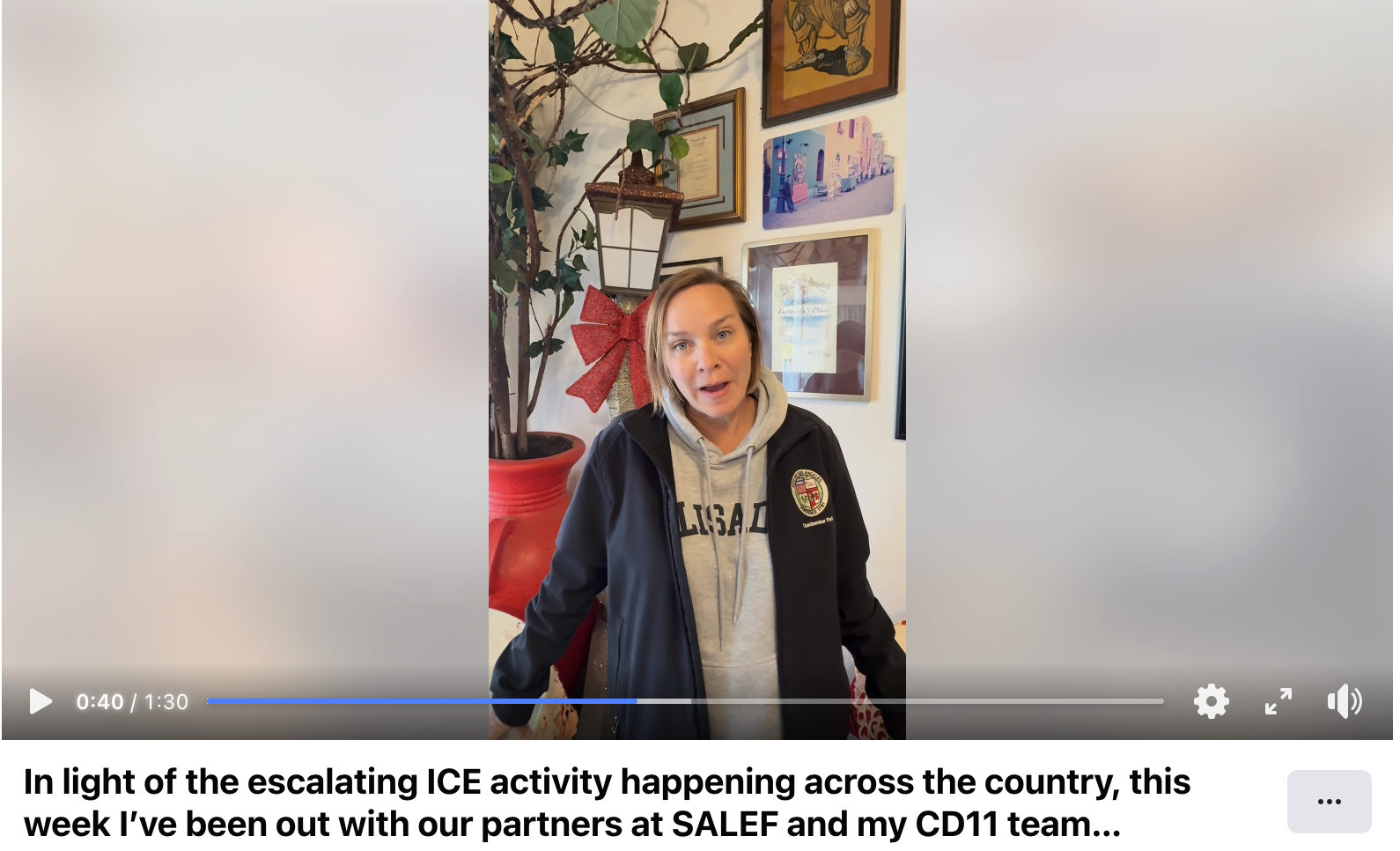
A filing from last fall shows that Traci Park’s office solicited a $570,000 donation from Airbnb to the Salvadoran American Leadership and Educational Fund (SALEF), routing corporate money through her council office to an immigrant-serving nonprofit while publicly promoting the partnership as support for vulnerable communities.
Behested payments are legal. But legality does not eliminate conflict-of-interest concerns. The size of the donation, the identity of the corporate donor, Park’s policy record on immigration and housing, and the appearance that an elected official helped broker a large transaction involving a political ally raise broader questions about the purpose and context of the contribution.
Park has repeatedly opposed strengthening sanctuary protections, defended preserving cooperation pathways with federal immigration enforcement, and has never condemned ICE raids affecting Westside families. She voted against funding lawyers for immigrants facing deportation, is expanding surveillance infrastructure that civil liberties advocates warn can be accessed by ICE, sided with LAPD when force was used against protesters opposing deportations, remained silent when constituents were detained by federal agents, and has consistently prioritized policing and enforcement over services that actually protect immigrant communities. The pattern is not mixed. It is consistent.
That context makes the SALEF partnership appear less like a substantive policy shift and more like a messaging contrast with her broader record, particularly when paired with a six-figure donation routed through her office from a corporation that had already invested heavily in her political career.
The corporate donor further complicates the picture. Airbnb gave $175,000 to Park’s 2022 campaign and has long been criticized for contributing to Los Angeles’ housing crisis by incentivizing the conversion of long-term rental units into short-term listings, a dynamic that disproportionately affects immigrant renters and working-class households. When a major campaign benefactor later provides a large behested payment arranged through the same elected official’s office, the optics resemble a feedback loop of political access, influence, and reputational benefit.
Those tensions became even more visible during the January wildfires that devastated Pacific Palisades and surrounding neighborhoods, a disaster Park has heavily centered in her political identity.
As displaced residents scrambled for housing, Airbnb faced accusations that prices on its platform surged during the emergency, fueling widespread fears of disaster profiteering. Others complained that its vouchers were useless.
The contradiction grew sharper when the Los Angeles City Attorney later filed litigation accusing Airbnb of price gouging during the wildfire emergency, alleging that listings exceeded legal rent limits and contributed to unlawful overcharges for displaced residents. The complaint asserts that thousands of listings increased prices beyond the legal 10 percent cap immediately after the emergency declaration and that Airbnb itself set many of those prices through its Smart Pricing tool, directly tying platform design to unlawful increases. The filing also alleges that tenants booked stays at those inflated prices and that Airbnb continued advertising unlawful rents for months after state officials intervened.
Beyond pricing, the lawsuit accuses Airbnb of deceptive verification practices, alleging the company represented hosts and property locations as “verified” even when identities were false or listings were inaccurately mapped miles from their true location. conduct prosecutors argue created consumer confusion during a moment of mass displacement. The complaint additionally highlights Airbnb’s profit structure, noting that the company’s service fees increase as rental prices rise, creating a direct financial incentive tied to higher emergency-era rents.
The timeline is notable. Park’s office solicited the $570,000 donation after price-gouging concerns had surfaced and while litigation against Airbnb was ongoing. In July 2025, the City Attorney formally sued the company over thousands of allegedly unlawful listings tied to the wildfire emergency. Three months later, on October 23, 2025, Park’s office executed the six-figure donation from the same company while it remained a defendant in that case. This sequence makes clear that Park entered the behested relationship with full public knowledge that Airbnb was facing serious allegations of disaster profiteering, consumer deception, and widespread price-gouging affecting displaced residents. That overlap reinforces concerns about self-dealing optics, where a corporation facing legal exposure simultaneously strengthens its relationship with a policymaker through a highly visible charitable transaction.
While the city was pursuing legal action against Airbnb for conduct tied to displacement, Park maintained financial and political ties to the company and later presented it as a partner in community relief. In practice, the relationship Park created functions as mutual reputation laundering: Airbnb gains a humanitarian narrative amid litigation, Park gains immigrant-outreach optics that soften an enforcement-heavy record, and SALEF becomes the vehicle through which the funds flow, raising its visibility and profile.
That tension is amplified by Park’s own policy choices during the wildfire recovery period. She failed to confront price gouging on behalf of displaced Palisadian constituents and opposed stronger renter protections, including voting against support for AB 246, legislation intended to prevent rent gouging and stabilize housing in the wake of the fires.
The selection of SALEF as the recipient introduces an additional layer of concern. SALEF provides important services, but it does not have a Westside footprint or a track record supporting immigrant families within CD11 neighborhoods. At a Mar Vista Recreation Center town hall where Park promoted expanded surveillance infrastructure, a longtime Oaxacan community leader raised concerns and blamed him for not previously engaging with her office.
The episode mirrors broader concerns among local organizers about the erosion of trusted community institutions. Park’s failure to preserve the Westside’s only FamilySource Center, a longstanding resource for immigrant families, stands in contrast to the elevation of an outside nonprofit in a highly publicized partnership.
SALEF’s nonprofit filings also show substantial reliance on government grants and politically connected funding streams, underscoring how large behested donations routed through elected offices can shape program visibility and public narratives. When those donations originate from entities with existing political relationships to the elected official facilitating them, the arrangement can blur the line between charitable support and politically advantageous self-dealing.
This arrangement reflects a clear contradiction. A corporation accused of disaster-era price gouging routed a major donation through an elected official who has opposed tenant and immigrant protections, and the partnership was presented as community relief even though none of the money went to the Palisades fire victims at the center of the lawsuit. The concern is classic self dealing based on reciprocal political benefit. Airbnb gained positive visibility during litigation and Park gained messaging that softened criticism of her record. And the fire victims who were harmed by Airbnb in the first place? They got nothing.